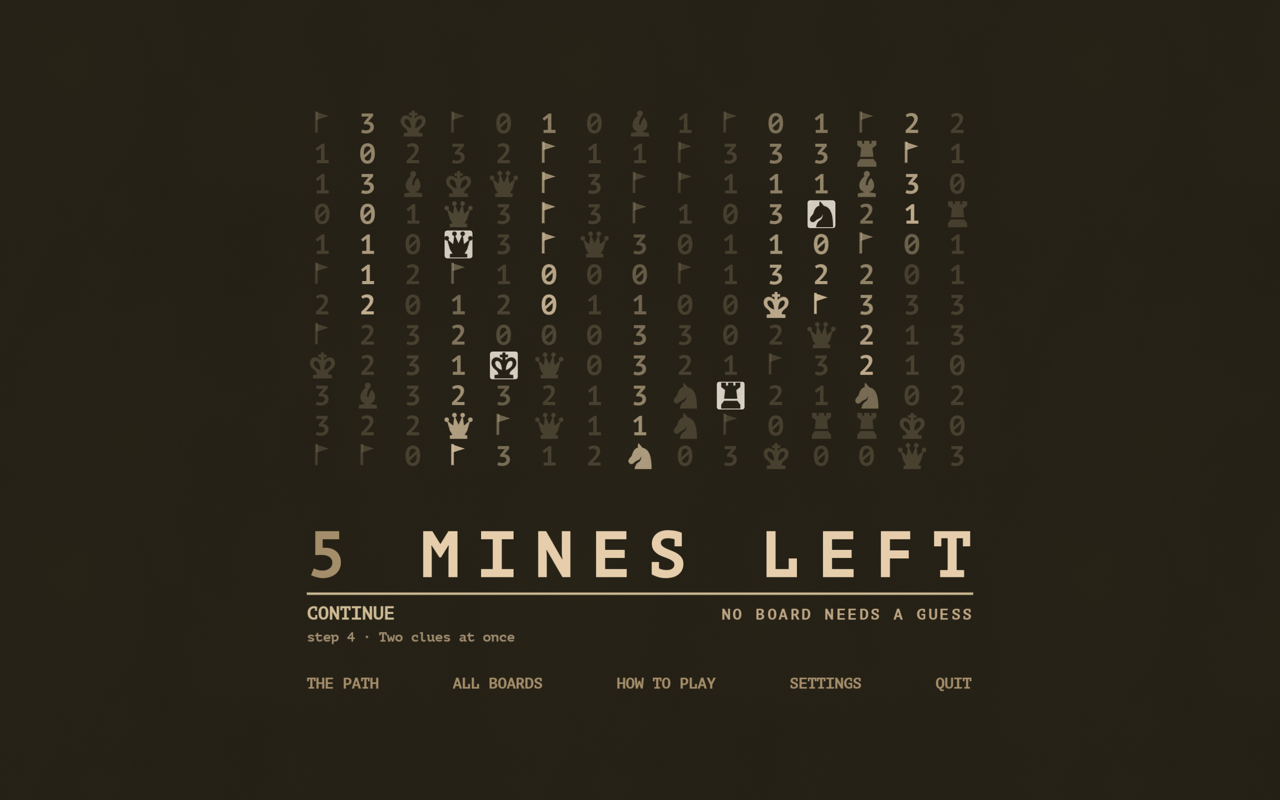
5 mines left
Minesweeper, counted by chess pieces.
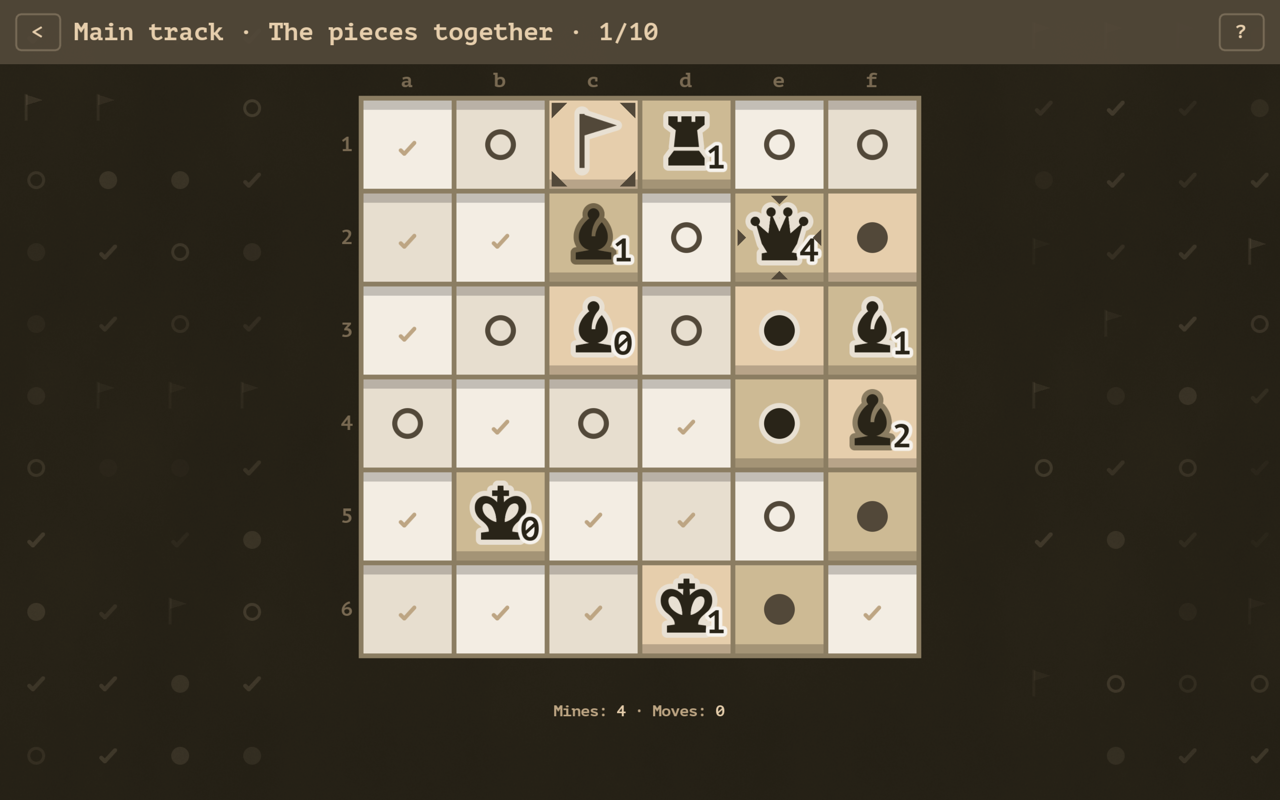
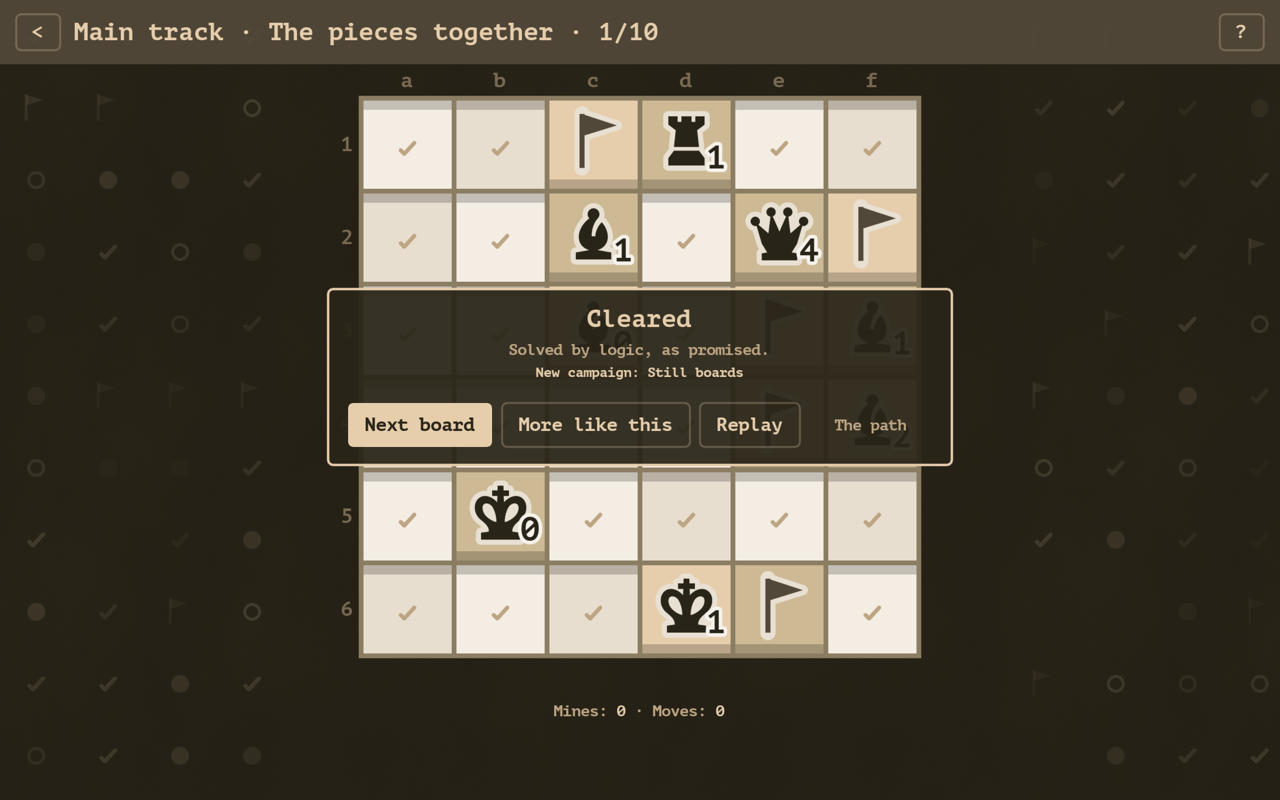
Five mines are hidden on a small board. The chess pieces standing on it are your only clues: each piece shows how many mines it can see, and a piece sees exactly the squares it could move to. A rook counts its row and its column, a bishop its diagonals, a knight its eight jumps, a king its neighbours.
No board needs a guess. Every board is built and checked by a solver: from any position you can reach by playing correctly, there is always a next flag or a next move you can prove. If you feel forced to guess, you have missed something — or we have, and we want to hear about it.
How to play
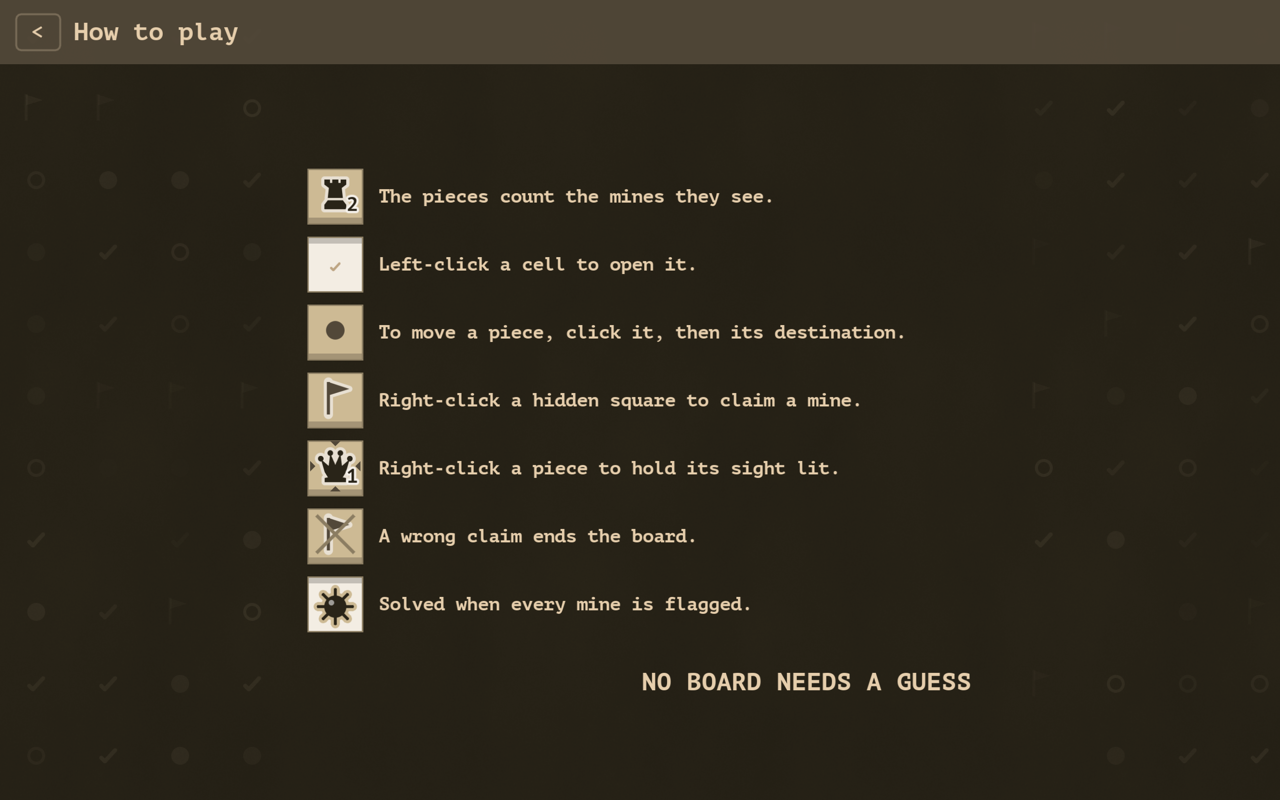
- Left click a square to open it. Left click a piece, then a square it sees, to move it there - the piece then counts from its new square.
- Right click a hidden square to claim a mine. A wrong claim ends the board.
- Right click a piece to hold its sight lit, so two clues can be compared at once.
- The board is solved when every mine is flagged.
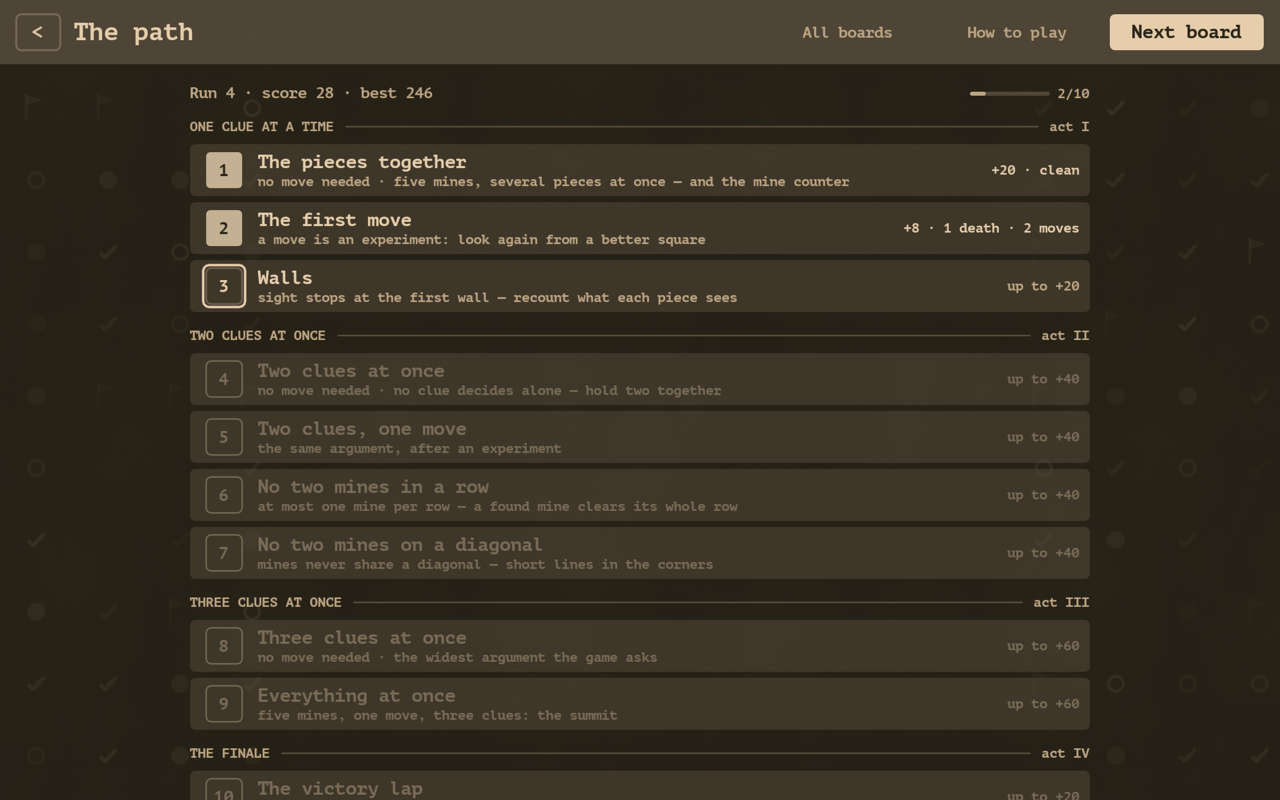
The path is a run of ten fresh boards, one per idea: the pieces together, the first move, walls, two clues at once, placement rules, three clues, the finale. Every board on the path is generated on the spot and comes with the same promise. All boards holds the curated set for practice.
This is an early build, played in the browser. It is here for feedback. Three things I would love to know: where you first did not understand what to do, whether any board made you guess, and what you thought the right click on a piece does. Comments below.
Best played with a mouse, in the frame or fullscreen.
Credits. Chess piece artwork: Chess Simple Assets by Maciej Świerczek, CC BY 4.0 (recoloured, pawn dropped). Typeface: PT Mono by Alexandra Korolkova and Isabella Chaeva, ParaType. Title music adapted from Debussy, "Des pas sur la neige". Built with LÖVE and love.js.
Leave a comment
Log in with itch.io to leave a comment.